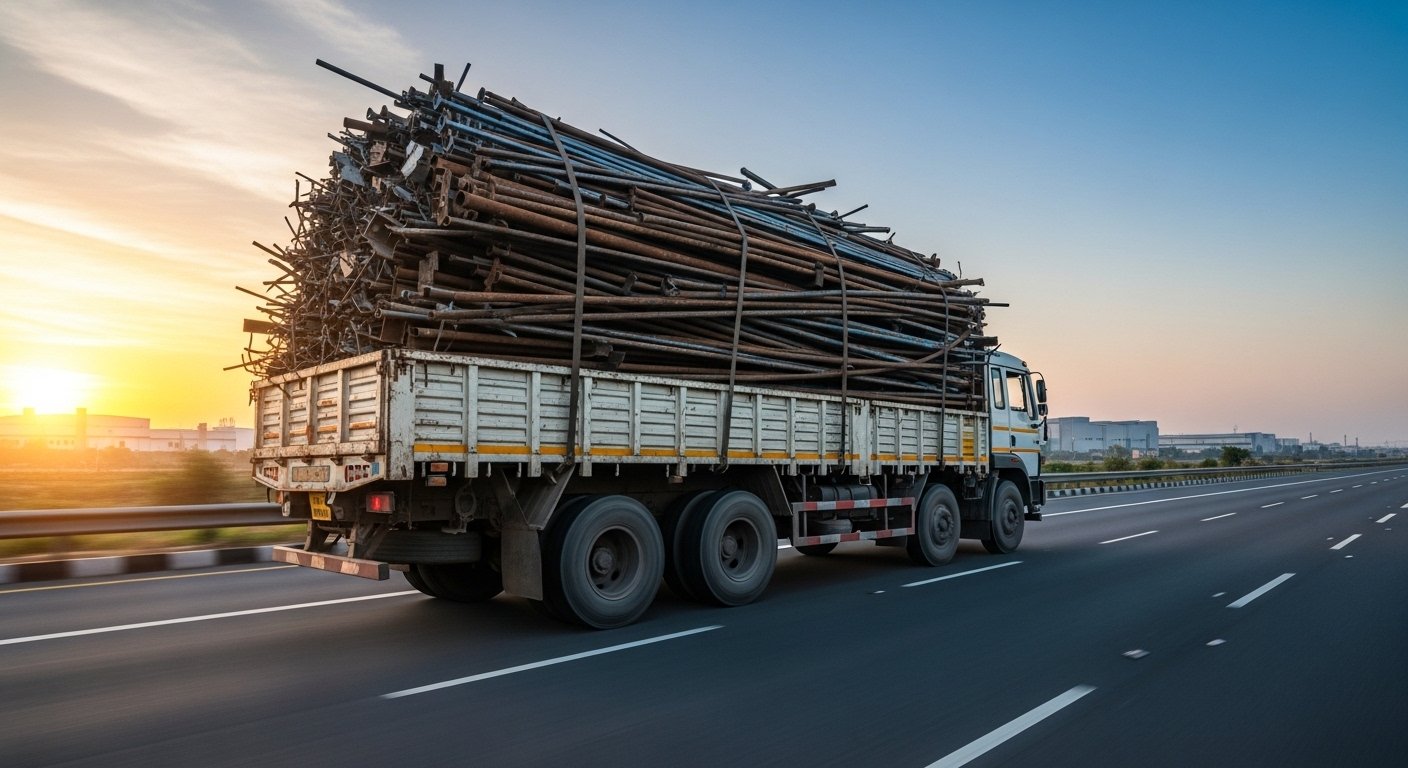
India imported over 5.6 million tonnes of ferrous scrap in just the first seven months of FY2026, up 45% on the previous year. Domestic scrap generation can’t keep pace with the country’s steel expansion, which means mills in Gujarat, Maharashtra, Tamil Nadu and Rajasthan are actively hunting overseas supply. If you have consistent material in the UK, US, EU, Australia or the Middle East, India is one of the most accessible markets you can enter right now.
What India Actually Buys
HMS 1 and HMS 2 make up the bulk of India’s ferrous imports, with 80:20 blends the most common specification mills quote against. Shredded scrap moves in serious volumes too, particularly into EAF mills around Surat and Raipur that can process tighter specs. Cast iron, turnings and bundles are traded but in smaller lots, usually under 200 MT, and Indian buyers discount them hard against HMS.
Non-ferrous is a separate conversation entirely. Copper, brass and aluminium each have their own HS codes, duty structures and buyer pools – re-rolling mills in Jamnagar buy most of the brass and aluminium, while copper goes primarily to wire-rod manufacturers in Silvassa and Palghar. Don’t approach a ferrous scrap buyer with a copper lot; the market is completely separate.
Minimum Quantities That Make Sense
Most Indian importers won’t engage seriously below 200 MT for a container-stuffed shipment, and for bulk vessel cargo the minimum that makes commercial sense is around 2,000 MT. Below that, freight costs per tonne eat your margin and Indian buyers know it – they’ll push your price down accordingly. If you’re sitting on 50–100 MT, find a consolidator in your country who can co-load into a 40ft container with other exporters.
Ports That Accept Scrap
India currently designates 14 ports for metallic scrap imports. The main commercial hubs are JNPT (Nhava Sheva), Mundra, Chennai and Kandla – these four handle the majority of volumes and have faster customs turnaround than smaller ports. Vizag (Visakhapatnam), Tuticorin and Pipavav are viable alternatives depending on where your buyer’s mill is located. Always confirm the port with your Indian buyer before booking freight, since customs clearance procedures vary and some mills have customs brokers tied to specific ports.
The PSIC Question
Pre-Shipment Inspection Certificate requirements confuse most first-time exporters. The simple rule: if your material originates from the USA, UK, Canada, Australia, New Zealand or the EU, and you’re shipping into one of the eight designated ports – JNPT, Mundra, Chennai, Tuticorin, Kandla, Kattupalli, Krishnapatnam or Mumbai – you don’t need a PSIC. The DGFT has formally exempted these origin-port combinations under amendments to Para 2.51 of the Handbook of Procedures.
What you still need regardless of origin is a supplier’s certificate confirming the shipment is free of radioactive materials and explosives. Don’t skip this. Indian customs runs every container through radiation portal monitors at the designated ports, and a failed scan means your cargo sits in the port yard while your buyer panics. Get the certificate from your yard or a licensed inspection agency before the vessel departs.
Exporters shipping from outside the safe-country list – UAE, Turkey, South Africa, Southeast Asia – still require a PSIC issued by a DGFT-authorised inspection agency. Agencies like Bureau Veritas, SGS and Intertek are authorised. Budget 5–7 working days and roughly $0.50–1.00 per MT for the inspection.
How Indian Buyers Price Scrap
Indian mill buyers benchmark against published indices – HMS 1&2 (80:20) CFR India is the most commonly referenced, with prices updated weekly by platforms that track actual traded deals. As of early 2026 HMS 80:20 was trading in the $310–$330 CFR range at Indian ports, though these figures are indicative and change with global steel market conditions.
Buyers quote on CFR or CIF basis, meaning they want you to include freight and insurance in your price. FOB deals happen but are less common – most Indian importers don’t have the shipping relationships to handle their own freight from overseas origin ports. Quote CFR to the buyer’s preferred port and build your freight cost in. Mundra and JNPT typically run $15–25 per MT cheaper on ocean freight from European and US ports compared to Chennai, simply due to vessel availability.
Payment and How Deals Close
Letters of Credit confirmed by a reputable international bank are the standard mechanism for first-time deals with Indian counterparties. Don’t ship on TT payment alone to an unknown buyer – the risk profile doesn’t justify it. Once you’ve done two or three successful shipments with the same buyer, some will move to a TT-on-document-presentation structure, but LC remains the clean option for new relationships.
The deal flow typically runs: price negotiation by email or phone → exchange of proforma invoice and purchase order → LC opened by Indian buyer’s bank → you arrange inspection (if required) and book vessel → documents sent to bank against LC → payment released. The whole cycle from first price discussion to vessel booking usually takes 10–20 working days with an organised buyer.
Documents You Need to Prepare
The standard document set for every shipment is: commercial invoice, packing list, bill of lading, certificate of origin, radiation-free certificate, and the PSIC if applicable. Indian buyers will also ask for a weight note from a certified weighbridge at origin and a quality/analysis certificate from your yard or the inspection agency. Some mills ask for photographic evidence of the material before loading – it’s worth providing this proactively since it speeds up buyer approval.
Finding the Right Indian Buyer
India has over 5,000 registered scrap importers but the active, creditworthy buyers number in the hundreds. Re-rolling mills, induction furnace operators and EAF plants all buy different grades at different volumes. Targeting the right buyer type for your material matters – selling shredded scrap to an induction furnace operator who primarily uses HMS won’t get you a good price. Platforms like Steel Baba connect international sellers directly with verified Indian buyers, which cuts the prospecting time significantly for exporters who are new to the market.
Steel Import Monitoring System Registration
India requires all ferrous scrap imports under Chapter 72 to be registered under the Steel Import Monitoring System before the Bill of Entry is filed. This is the Indian buyer’s responsibility, not yours, but you should confirm your buyer has their SIMS registration active before you finalise the deal. A buyer who hasn’t sorted SIMS will cause customs delays at arrival, which means demurrage costs that they’ll try to argue you should share.
Timing Your Shipments
India’s monsoon season runs June through September. Port congestion increases, mill consumption of scrap dips as construction activity slows, and buyers become cautious. Prices at Indian ports typically soften 5–10% during this window compared to Q4 and Q1 levels. Plan to have your vessel arrive before mid-May or wait until October. The October–March window historically gives exporters the strongest demand and least port friction.
Scrap trade data and price references in this article are indicative figures as of early 2026 and subject to change. For official import policy, classification and port designations, refer to the DGFT Handbook of Procedures at dgft.gov.in.