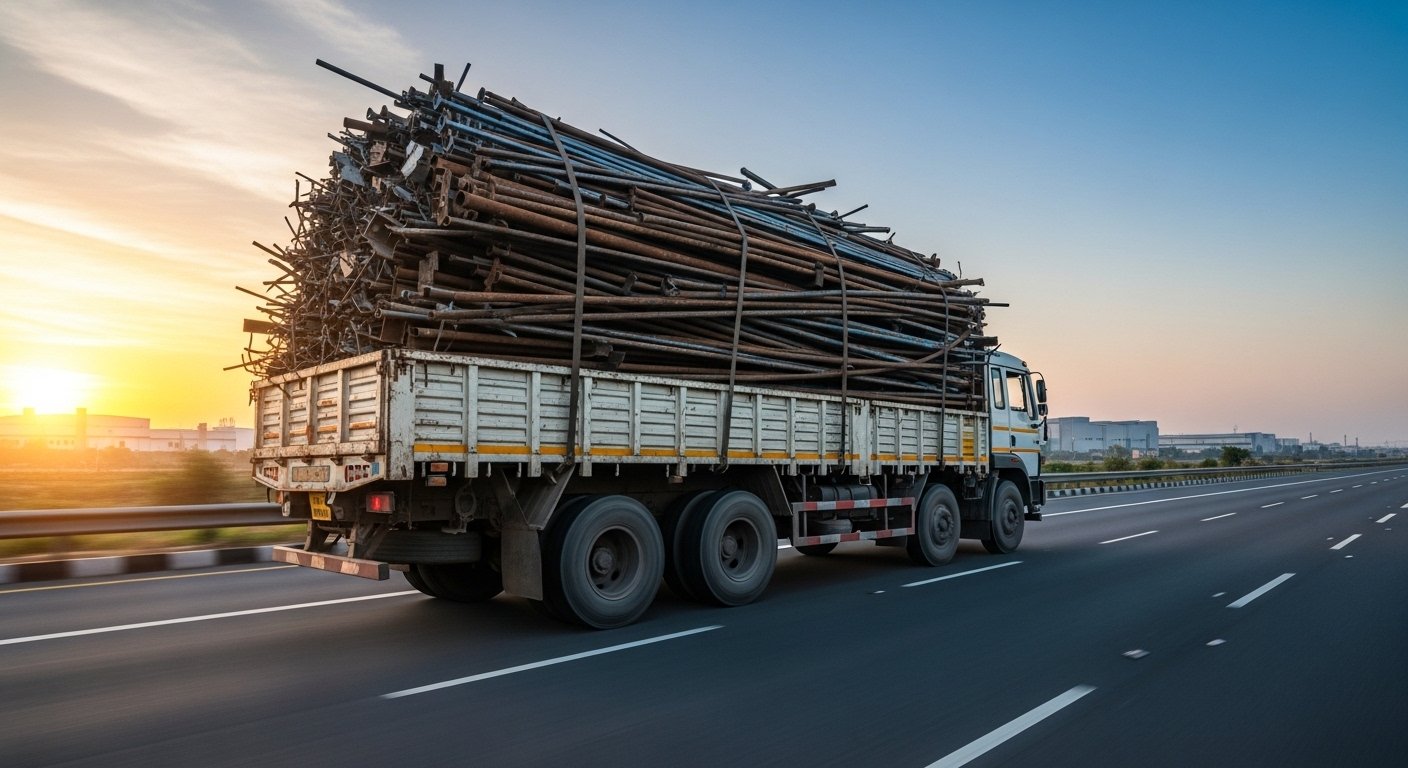
A rejected load is not just a failed sale. It’s a freight cost you pay twice. A driver who sat at a mill gate for three hours. A relationship with a buyer that takes a hit. And material that now needs to be re-sorted, repriced, and moved again – at a lower rate than you originally got offered.
The math on a single rejection is brutal. Freight both ways on a 20-tonne truck: ₹8,000 – ₹20,000 depending on the route. That’s before you account for the time, the re-sorting cost, and the lower rate from the next buyer who knows your lot was already rejected once.
Every rejection on this list is preventable. Every fix is something you can do in your own yard before the truck moves.
1. Galvanized Steel in an HMS 1 Lot
The most common reason for full load rejection at induction furnaces across India.
Galvanized steel has a zinc coating applied to prevent corrosion. It looks like regular steel – dull silver-grey surface, sometimes faded with age. Easy to miss in a large pile. Impossible to ignore in a furnace.
When galvanized steel melts, zinc vaporizes at around 907°C – well below steel’s melting point of 1,370°C. That zinc vapor exits through the furnace lining, damages the refractory, creates toxic fumes, and contaminates the melt. A single galvanized piece in a 20-tonne heat can cause the entire batch to fail quality specifications.
Mill operators have zero tolerance for this. They train their gate staff specifically to spot it.
How to identify galvanized steel in your lot:
- Surface has a distinctly spangly, crystalline pattern under direct light – called “spangle”
- Older galvanized pieces have a dull silver-grey matte finish
- Scratch the surface – bright shiny zinc appears underneath the weathered exterior
- Common sources: old roofing sheets, corrugated iron, fence posts, water tanks, electrical conduit
The fix: Walk your pile before loading. Pull every piece with that silver-grey surface. Set it aside as a separate lot – it has its own value stream at yards that process galvanized separately, just not in an HMS 1 lot.
2. Non-Ferrous Contamination
Copper is the one that shuts deals down fastest. But any non-ferrous material – aluminum, brass, lead, zinc, tin – in a ferrous scrap lot creates problems.
Here’s the technical reason: copper, tin, and arsenic are what metallurgists call “tramp elements” – they cannot be removed from steel once melted. Even 0.1% residual copper causes surface cracking when the steel is later rolled or forged. Mills producing structural steel, TMT rebar, or wire rod have strict limits. Exceeding them means their finished steel fails quality tests and gets rejected by their own customers.
Wet scrap charging in a furnace is also dangerous. Charging wet or damp material in an induction furnace can cause steam explosions – a serious safety hazard that operators take extremely seriously.
| Non-Ferrous Contaminant | Source | Risk to Mill |
|---|---|---|
| Copper | Motor windings, wire, bushings | Tramp element – ruins steel quality |
| Zinc | Galvanized coating | Furnace lining damage, fumes |
| Aluminum | Brackets, castings attached | Slag contamination |
| Lead | Old paint, batteries | Toxic fumes, health hazard |
| Tin | Tinplate, food cans | Tramp element similar to copper |
The fix: Magnet sweep across the entire lot before loading. Anything the magnet doesn’t grip firmly – pull it out. Remove copper wire from motors before the motor goes in the pile. Strip aluminum brackets, brass fittings, and any non-ferrous attachments before loading. Ten minutes at your yard. Every time.
3. Misgraded Material – HMS 2 Sold as HMS 1
Gate staff at serious mills check thickness. They pull pieces at random from the loaded truck and measure them visually and physically.
HMS 1 (80:20) requires at least 80% of the material to be over 6mm thick. Thin sheet, light gauge material, and anything that bends easily by hand does not qualify. If the gate check finds 30-40% of your load is thin material, the whole lot comes back – or gets repriced to HMS 2 on the spot.
The spot repricing is actually the better outcome. Some buyers send the truck back without discussion.
The fix:
- Pick 10 random pieces from your pile before loading. Bend each one by hand.
- If it bends, it’s thin – not HMS 1.
- Separate thin material into its own pile and price it as HMS 2.
- A sorted two-grade dispatch earns more total than one mixed load priced at the worst grade.
Understanding what buyers test during purity inspection shows you the full checklist gate staff run through – not just the thickness check.
4. Excessive Moisture
Wet scrap is a safety issue before it’s a commercial one.
Charging wet or damp material into a running induction furnace creates steam pressure that can cause violent steam eruptions – splashing molten metal outside the furnace. Mill operators are trained to refuse wet loads on sight for safety reasons, not just commercial ones.
Beyond safety: moisture adds weight that buyers aren’t paying for. A 3% moisture content on a 20-tonne load at ₹32,000/MT is ₹19,200 in water weight you’ve presented as steel weight. Buyers deduct for it – and they’re right to.
| Moisture Level | How It Shows | Typical Deduction |
|---|---|---|
| Surface damp (1-2%) | Slightly dark surface | ₹200 – ₹400/MT |
| Moderate moisture (3-5%) | Visible wet areas | ₹600 – ₹1,000/MT |
| Heavy moisture (5%+) | Dripping water, heavy rust | Rejection or ₹1,500+/MT |
| Oily turnings | Oil smell, dark surface | ₹1,200 – ₹2,000/MT |
The fix:
- Store scrap covered – tarpaulin over stockpiles during and after rain
- Never load immediately after rain. Wait 24 hours minimum for surface moisture to dry
- Turning and boring scrap needs 48 hours to drain and air-dry after cutting oil accumulation
- If the pile was rained on, dry it. The weight you lose is weight you were never getting paid for
5. Stainless Steel Mixed Into Carbon Steel Lots
Stainless steel looks like regular steel to the untrained eye. Under XRF analysis – which serious mills now run on every incoming lot – it’s immediately identifiable through its high nickel and chromium content.
Chromium and nickel are the problem. They change the metallurgy of the melt, pushing the furnace operator’s heat out of carbon steel specification and into alloy territory. For mills making standard carbon steel products, an unexpected alloy heat is an expensive problem.
Some mills simply reject any lot where XRF detects stainless above threshold. Others will accept it at a significantly lower rate as “mixed alloy scrap.”
How to identify stainless in your pile:
- Stainless stays bright and shiny even after years of exposure – it doesn’t rust the way carbon steel does
- A strong magnet identifies most grades: austenitic stainless (304, 316) has weak or no magnetic response; ferritic and martensitic grades (400 series) are magnetic but lighter in response than carbon steel
- Common sources: kitchen equipment, food processing machinery, chemical plant components, medical equipment
The fix: Separate stainless as its own grade – it has real value, just at different buyers. Stainless scrap goes to stainless steel re-melters, not carbon steel induction furnaces. Mixing it into HMS loses you the stainless premium and risks rejection of the carbon steel lot.
6. Radioactive Contamination
This one is rare. But when it happens, the consequences are severe – immediate full rejection, regulatory notification, and potential quarantine of the entire lot pending clearance.
Radioactive material enters the scrap stream from medical equipment (cobalt-60, iridium-192 sources), industrial gauges, and abandoned scientific instruments. It’s not visible. It has no smell. And at major mill gates across India, radiation portal monitors are now standard equipment.
The Mayapuri incident in Delhi in 2010 – where a dismantled radioactive cobalt-60 source from a Delhi University equipment auction entered the scrap trade – resulted in deaths and a major radiation emergency. It changed how serious mills approach incoming scrap screening permanently.
The practical implication for sellers: If your material includes scrap from hospitals, medical institutions, industrial measurement equipment, or government/scientific facility clearances – disclose this to the buyer upfront. Don’t assume it’s clean. Buyers with radiation monitors will find what’s there whether you tell them or not. And the outcome of not telling them is far worse than the outcome of disclosing and getting the lot checked first.
7. Cast Iron Mixed Into HMS Lots
CI (cast iron) behaves differently in an induction furnace than carbon steel. High carbon content – 2 to 4% versus 0.15 to 0.35% in mild steel – causes carbon pickup in the melt, pushing the heat out of carbon steel specification.
Most induction furnaces cap CI content in their furnace burden at 10 – 15% maximum. Above that, heat quality suffers. When gate staff spot obvious CI pieces – engine blocks, brake drums, machine castings – mixed into an HMS lot, they either reject the load or apply a CI deduction to the entire lot.
How to identify CI in your pile:
- Drop it – cast iron fractures and chips. Mild steel dents and bends.
- Freshly broken surface is grey and granular – distinctly different from steel’s brighter fracture
- Heavier than it looks – CI is denser per volume than most steel forms
- Common pieces: engine blocks, cylinder heads, brake drums, manhole covers, old water pipes
The fix: Separate CI into its own pile. It has real value – sometimes better value than HMS when sold to the right foundry buyer. The difference between HMS and cast iron scrap value explains exactly which buyers pay more for CI and why routing it to a foundry instead of a steel mill consistently returns better rates.
8. Heavy Paint, Rubber, and Non-Metallic Attachments
Paint, rubber gaskets, plastic insulators, and epoxy coatings all burn off in the furnace. That burn-off becomes slag. And every 1% of slag formed in a furnace costs roughly 10 kWh of additional energy per tonne. Mills track this precisely – it directly affects their power bill on every heat.
Heavy paint coatings, thick rubber attached to scrap, and plastic components mixed into a load all increase slag generation and reduce net yield. Buyers factor this in with a rate deduction – or reject lots where contamination is visually excessive.
| Non-Metallic Contaminant | Impact | Deduction Range |
|---|---|---|
| Heavy paint layers | Slag increase, yield loss | ₹200 – ₹400/MT |
| Rubber attached to metal | Slag, fume generation | ₹300 – ₹600/MT |
| Plastic components | Slag, toxic fumes | ₹300 – ₹800/MT |
| Wood or insulation mixed in | Slag, volume inflation | Rejection possible |
| Excessive rust scale | Yield loss, weight inflation | ₹200 – ₹500/MT |
The fix: Strip rubber seals and gaskets from pipe scrap before loading. Remove plastic electrical insulators from wire scrap. Avoid loading pieces with thick epoxy or paint coatings unless pricing them as a lower grade. Rust scale on HMS can be reduced by storing material dry – wet conditions accelerate scale formation.
9. Documentation Mismatch at the Gate
This one has nothing to do with the material. The scrap is fine. The paperwork kills the deal.
E-Way Bill weight doesn’t match the weighbridge slip. The HSN code on the invoice says 7304 instead of 7204. The buyer’s GSTIN on the invoice has one wrong digit. The E-Way Bill expired in transit.
The gate officer at a serious mill has authority to refuse entry to any truck where documents are inconsistent. Some mills have experienced significant GST fraud through scrap channels – fake invoices, circular trading, ITC manipulation – and their gate procedures reflect that. Document integrity is not optional.
| Document Error | Consequence |
|---|---|
| Expired E-Way Bill | Truck turned away, penalty risk |
| Weight mismatch (EWB vs weighbridge) | Detention, inquiry |
| Wrong HSN code | GST mismatch, notice risk |
| Wrong buyer GSTIN | Invalid document chain |
| Missing delivery challan | Unregistered seller loads refused at some mills |
The fix: Generate the E-Way Bill after weighing, not before. Double check the buyer’s GSTIN before generating. Confirm E-Way Bill validity against your route distance before dispatch. Carry original documents – not photocopies alone.
10. Oversized or Undersize Material
Induction furnaces have a fixed crucible size. Material that’s too large – long beams, thick structural sections, railway rails over certain lengths – physically cannot be charged through the furnace mouth. The operator won’t even attempt it.
Maximum piece size for most Indian induction furnaces: 600mm to 800mm in any dimension for standard 5-20 tonne furnaces. Industrial shredded scrap is accepted in any size because it’s already processed down. Structural scrap needs to be cut.
Equally, excessively light, fine material – thin turnings under 1mm, dust, very fine borings – causes charging problems. Fine particles don’t sit stably in the furnace burden and can create bridging issues.
The fix: Cut oversize pieces before loading. Long beams, railway rails, structural sections all need to be cut to under 600mm for most mill acceptances. Ask your buyer their maximum piece length before dispatch on structural lots – specifications vary by furnace size.
The Pre-Dispatch Checklist – Run This Before Every Truck
One structured check before loading eliminates 90% of all rejection scenarios.
- ☑ Magnet sweep complete – non-ferrous pieces removed
- ☑ Galvanized material separated – not in HMS 1 pile
- ☑ Thickness check on 10 random pieces – thin material in HMS 2 pile
- ☑ CI separated – engine blocks, brake drums, castings in own pile
- ☑ Rubber, plastic, and heavy paint stripped or removed
- ☑ Material dry – no surface moisture, turnings drained
- ☑ No stainless steel mixed into carbon steel lot
- ☑ No oversized pieces – all cut to under buyer’s maximum length
- ☑ Documents ready – E-Way Bill generated after weighing, correct HSN, valid GSTIN
- ☑ E-Way Bill validity checked against route distance
This takes thirty minutes on the yard. A rejection costs you two to four hours, freight both ways, and the rate discount from the next buyer.
What to Do If Your Load Gets Rejected Anyway
Sometimes it happens despite good preparation. A buyer’s gate staff is overly aggressive. A borderline piece gets flagged that shouldn’t. Circumstances outside your control.
When rejection happens:
- Get the rejection reason in writing – ask for a written note or at minimum a WhatsApp message stating the specific reason. This protects you if the rejection is incorrect or opportunistic.
- Check the return weight – insist on a certified weighbridge slip for the returning load before it leaves the mill premises.
- Don’t accept vague reasons – “quality not up to mark” is not a reason. “Galvanized material found in HMS 1 lot – 15% estimated” is a reason. Push for specifics.
- Re-sort before the next dispatch – if the rejection was legitimate, fix the specific issue before approaching the next buyer. Don’t send the same lot to buyer 2 without addressing what buyer 1 flagged.
- Re-price appropriately – a lot that was rejected as HMS 1 should be quoted honestly as HMS 2 to the next buyer. Trying to pass it as HMS 1 again will result in a second rejection.
Knowing what dealers don’t tell sellers about how lots get assessed gives you a clearer picture of when a rejection is legitimate versus when it’s a negotiating tactic dressed up as a quality issue.
Rejection criteria and acceptance standards vary by mill, furnace type, and steel specification requirements. Always confirm grade and contamination tolerance limits with your specific buyer before dispatch.