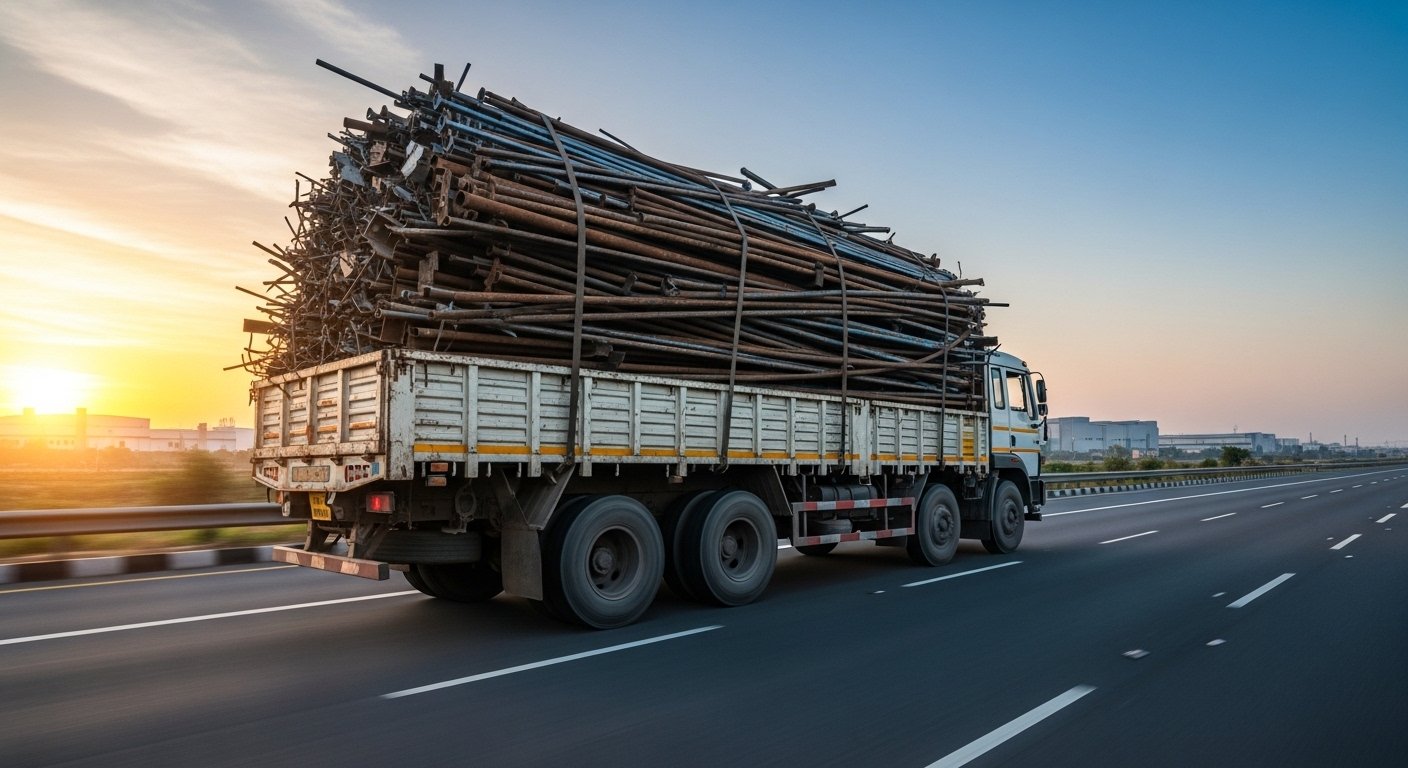
Port choice is not just a logistics decision. It determines your buyer’s total landed cost, clearance speed, and how quickly material moves from vessel to furnace. Pick the wrong port for the wrong destination and your buyer’s economics deteriorate by ₹1,000 – ₹2,500/MT in avoidable freight before the material reaches the weighbridge.
India handled over 855 million tonnes of cargo at major ports in FY2024-25. Scrap metal is a growing share of that volume – ferrous scrap imports jumped 45% in FY2025-26 as domestic supply continued to fall short of what Indian induction furnaces need. Every major port on India’s west and east coast now has radiation portal monitors and container scanners operational specifically for scrap clearance. But they are not equally positioned for every buyer.
Here is the complete comparison.
The 11 PSIC-Exempt Ports – Quick Reminder
Before getting into the port-by-port breakdown, the regulatory context matters. Not every Indian port accepts scrap from all countries. The 11 PSIC-exempt ports – where material from USA, UK, EU, Canada, Australia, and New Zealand can arrive without a Pre-Shipment Inspection Certificate – are the ones most international exporters use. Full details of the exemption framework and port list are in the India scrap import PSIC exemption guide.
For non-exempt country origins, PSIC is required regardless of port. All ports listed below accept PSIC-carrying shipments from any country.
JNPT – Nhava Sheva, Mumbai
JNPT is India’s largest container port and the default choice for most international scrap exporters shipping to Maharashtra, Pune, and the Jalna induction furnace belt. It handles the highest volume of containerised scrap of any Indian port.
Why exporters choose it:
- Largest container handling infrastructure in India – less vessel congestion risk than smaller ports
- Direct road connectivity via NH-52 to Jalna (6-7 hours), Pune (2 hours), and Nagpur (8 hours)
- S&P Global Platts benchmarks CFR Nhava Sheva as the reference price for Indian scrap imports – the most liquid price point in India
- Established CHA (Customs House Agent) ecosystem with deep experience in scrap clearance
The trade-offs:
- Port congestion is real and periodic – during peak import periods, free storage can run out before clearance completes
- Free storage period for FCL containers: 7 days. After that, ₹11.20/MT/day for the next 7 days, escalating to ₹44.80/MT/day thereafter
- Road freight to Jalna cluster runs ₹1,600 – ₹1,900/MT depending on truck availability
- Higher CHA and terminal handling charges compared to Gujarat ports
Best for: Maharashtra-based mills, Pune industrial buyers, Jalna and Aurangabad scrap clusters.
Mundra Port, Gujarat
Mundra has become India’s second most important scrap import port and is growing faster than any other in this category. It’s privately operated by Adani Ports – which brings both advantages and some exporter concerns about pricing transparency.
Why exporters choose it:
- Significantly less congested than JNPT for bulk and container operations
- Faster customs clearance turnaround – 3-5 days versus 5-8 days at JNPT on average
- Direct rail connectivity to Rajkot, Ahmedabad, Surat, and Bhavnagar steel clusters
- Lower terminal handling charges than JNPT – roughly 12-15% cheaper on port-side costs
- Growing infrastructure investment – Adani has expanded scrap-handling facilities significantly since 2022
The trade-offs:
- Slightly longer ocean transit from US East Coast versus Mumbai routing
- Rail freight to inland destinations works well for bulk – container drayage to some Gujarat locations can be slow
- Inland freight to Rajkot runs ₹800 – ₹1,100/MT; to Ahmedabad ₹600 – ₹900/MT
Best for: Gujarat mills, Rajkot foundry cluster, Surat and Ahmedabad steel buyers.
Kandla (Deendayal Port), Gujarat
Kandla is India’s largest port by total cargo tonnage but handles less containerised scrap than either JNPT or Mundra. It’s the preferred entry point for bulk vessels – break-bulk scrap shipments of 5,000 MT and above rather than containerised lots.
Why exporters choose it:
- Excellent bulk vessel handling infrastructure – purpose-built dry bulk berths
- Strong connectivity to the Kutch industrial belt and inland to Rajkot and Ahmedabad
- Lower port charges than both JNPT and Mundra for bulk cargo
- Good rail head connectivity directly at port
The trade-offs:
- Less suited to containerised scrap than Mundra – container handling slower
- CHA ecosystem less specialised for scrap clearance compared to JNPT
- Some infrastructure constraints during monsoon season – June to September
Best for: High-volume bulk shipments of 5,000 MT+ to Gujarat and Rajasthan buyers.
Hazira Port, Surat, Gujarat
Hazira is a smaller port but strategically important for South Gujarat’s industrial corridor – home to significant induction furnace capacity in Surat and surrounding areas.
Why exporters choose it:
- Direct access to Surat industrial cluster – the port sits within the industrial zone
- Fast clearance for smaller shipments – less congestion than major ports
- PSIC-exempt status confirmed in the January 2022 DGFT notification
The trade-offs:
- Limited infrastructure for very large vessels
- Best suited to containerised shipments of under 1,000 MT per call
- Inland connectivity limited compared to Mundra or Kandla
Best for: Surat-specific buyers, smaller containerised lots to South Gujarat.
Chennai Port, Tamil Nadu
Chennai is the gateway for South India’s steel and scrap market – Coimbatore, Salem, and the broader Tamil Nadu industrial belt. India’s ferrous scrap imports jumped significantly through Chennai in FY2025-26 driven by growing induction furnace capacity in Tamil Nadu.
Why exporters choose it:
- Strong connectivity to Coimbatore (5 hours by road), Salem (3.5 hours), and Chennai industrial zones
- Well-established CHA community experienced in scrap documentation
- Competitive port charges versus JNPT
- Growing container handling capacity post-infrastructure upgrades
The trade-offs:
- Road freight to North Indian buyers is prohibitive – Chennai is geographically constrained to South India supply
- Monsoon period (October-December for Chennai) can cause vessel delays
Best for: Tamil Nadu mills, Coimbatore and Salem induction furnace buyers, Karnataka buyers.
Adani Gangavaram Port, Andhra Pradesh
Gangavaram is the newest addition to the PSIC-exempt port list – added in February 2024 via DGFT Public Notice. It serves the Andhra Pradesh and Telangana industrial corridor, including the growing Vizag steel belt.
Why exporters choose it:
- Direct access to Vizag steel cluster and AP industrial corridor
- Less congested than JNPT – faster clearance for buyers in this region
- Road connectivity to Hyderabad runs approximately 5-6 hours
The trade-offs:
- Limited history for scrap clearance – procedures still maturing compared to established ports
- Smaller CHA ecosystem – fewer specialists for complex scrap documentation queries
- Less liquid market – fewer buyers and traders operating through this port compared to JNPT or Mundra
Best for: Andhra Pradesh and Telangana mills, Vizag and Hyderabad area buyers.
Port-by-Port Quick Comparison
| Port | State | Best For | Clearance Speed | Congestion Risk | Container or Bulk |
|---|---|---|---|---|---|
| JNPT (Nhava Sheva) | Maharashtra | Maharashtra, Jalna, Pune | 5-8 days | High | Both |
| Mundra | Gujarat | Gujarat, Rajkot, Ahmedabad | 3-5 days | Low-Medium | Both |
| Kandla | Gujarat | High-volume bulk to Gujarat | 4-7 days | Low | Bulk preferred |
| Hazira | Gujarat | Surat cluster | 2-4 days | Low | Container |
| Chennai | Tamil Nadu | South India, Tamil Nadu | 4-7 days | Medium | Both |
| Kamarajar (Ennore) | Tamil Nadu | Chennai corridor | 4-6 days | Medium | Both |
| Tuticorin (V.O.C) | Tamil Nadu | Deep South India | 3-6 days | Low | Both |
| Krishnapatnam | Andhra Pradesh | AP buyers | 3-5 days | Low | Both |
| Gangavaram | Andhra Pradesh | Vizag, Hyderabad | 3-5 days | Low | Both |
| Mumbai Port | Maharashtra | Mumbai industrial | 4-7 days | Medium | Both |
| Kattupalli | Tamil Nadu | Chennai region | 3-5 days | Low | Container |
The Inland Freight Reality
Port clearance cost is only half the landed cost equation. Inland freight from port to mill gate is where geography creates or destroys deal margins.
| Port → Destination | Approximate Distance | Road Freight (per MT) |
|---|---|---|
| JNPT → Jalna | ~340 km | ₹1,600 – ₹1,900 |
| JNPT → Pune | ~95 km | ₹600 – ₹800 |
| JNPT → Nagpur | ~830 km | ₹2,500 – ₹3,200 |
| Mundra → Rajkot | ~155 km | ₹800 – ₹1,100 |
| Mundra → Ahmedabad | ~385 km | ₹1,200 – ₹1,500 |
| Chennai → Coimbatore | ~500 km | ₹1,400 – ₹1,800 |
| Kandla → Surat | ~300 km | ₹1,000 – ₹1,400 |
A Maharashtra buyer in Nagpur receiving material through JNPT pays ₹2,500 – ₹3,200/MT in road freight alone. The same buyer routing through Krishnapatnam or Kamarajar might save ₹500 – ₹800/MT in freight by taking a longer ocean leg to a closer port. These calculations are worth running before you confirm the discharge port with your buyer.
What Happens at the Port – Step by Step
Understanding the clearance sequence helps set realistic expectations on timing for both sides of the deal.
Vessel arrives and customs entry is filed simultaneously – this can be done by the CHA before vessel arrival using arrival notice documents. Port health clearance is first – typically same day. Radiation portal monitor scan happens as containers move from vessel to yard. If scan is clear, containers proceed to the customs examination queue. Physical examination of scrap containers runs at 100% – every container gets opened and checked. After physical exam clearance, the bill of entry is assessed, duties are paid, and out-of-charge is issued.
From vessel arrival to out-of-charge: 3 – 8 days at efficient ports like Mundra, 5 – 10 days at busier ports like JNPT during peak periods. The variation depends on customs officer availability, examination queue length, and how clean your documentation is from day one.
The Document Pack That Speeds Clearance at Any Port
Documentation errors are the single biggest cause of clearance delays across all Indian ports. A complete, accurate, consistent document pack presented on the day of vessel arrival – not after – is what separates 4-day clearance from 10-day clearance.
The complete document checklist for Indian customs clearance – every document, who prepares it, and what common errors to avoid – is covered in the India customs clearance documents guide. Getting this right before the vessel sails is the single highest-impact action either party can take to protect the clearance timeline.
Which Port Should Your Buyer Be Using
The answer comes down to three variables: where the buyer’s mill or warehouse is located, what shipping frequency and vessel size works for the trade volume, and what clearance timeline the buyer’s working capital can support.
For most first-time India trade relationships involving Maharashtra buyers – which includes the active Jalna induction furnace market where significant domestic HMS trading also takes place – JNPT is the default. Check the live iron scrap rates in India to understand what domestic buyers in those markets are currently paying – that’s the price context your imported material is competing against at the mill gate.
Port charges, clearance timelines, and infrastructure details are indicative as of February 2026. Port tariffs are subject to revision by port authorities and the Tariff Authority for Major Ports (TAMP). Always confirm current charges with your CHA and the relevant port authority before finalising shipping costs in any buyer contract.