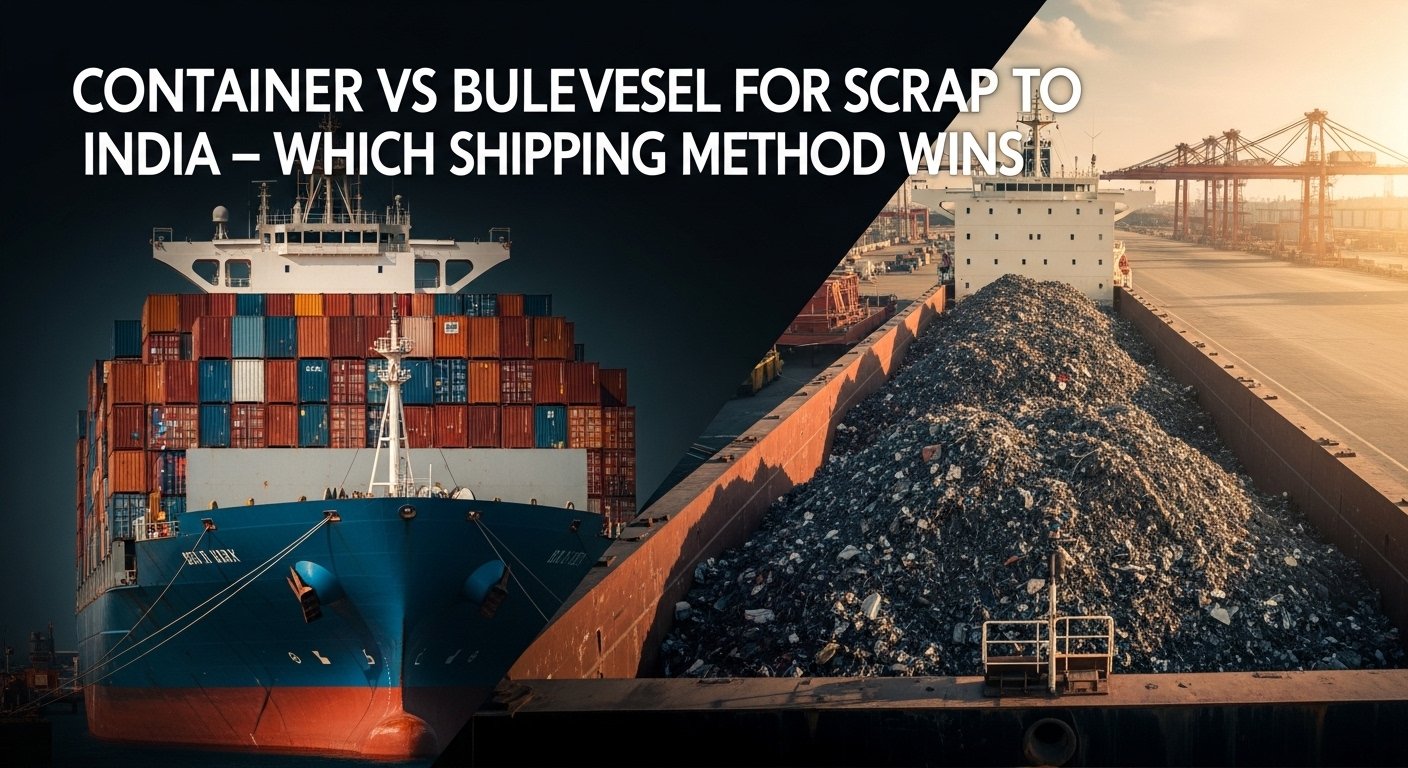
The instinct most first-time exporters follow is wrong. Small yards default to containers because it’s what they know. Large yards default to bulk because they’ve always done it that way. Neither approach is right without running the actual numbers for the specific trade lane, volume, and buyer location.
Get this wrong and you’re either overpaying USD 15 – 25/MT in unnecessary freight costs, or you’re accepting a vessel charter structure that exposes you to demurrage liability that can wipe out an entire deal’s margin in under two weeks.
Here’s how to make the right call every time.
The Volume Thresholds That Drive the Decision
There’s no universal breakeven point between containerised and bulk shipping. It depends on the trade lane, current freight market conditions, the buyer’s port, and the buyer’s ability to handle different cargo formats. As a working guide for India-specific scrap trade:
| Volume | Recommended Method | Reason |
|---|---|---|
| Under 200 MT | FCL containers only | Bulk charter minimum is 3,000 MT – not viable |
| 200 – 1,000 MT | FCL containers | Flexibility, no charter minimum, easier documentation |
| 1,000 – 3,000 MT | FCL containers or mini-bulk | Depends on freight market and port access |
| 3,000 – 10,000 MT | Bulk vessel (handysize) | Per-tonne freight advantage kicks in |
| 10,000 MT+ | Bulk vessel (supramax/handymax) | 30-50% cheaper per tonne than containers at this scale |
Most international exporters shipping to Indian induction furnace buyers are in the 200 – 2,000 MT range per shipment. That’s firmly container territory. Bulk vessels become relevant primarily for large traders, processors, and aggregators assembling volumes from multiple yards.
Container Shipping – The Complete Cost Picture
A standard 20-foot container holds approximately 18 – 22 MT of loose HMS depending on packing density. A 40-foot container carries 22 – 28 MT. Shredded scrap packs denser – a 20-footer can carry 22 – 25 MT of shredded versus 18 – 20 MT of loose HMS 1.
Freight rates (indicative, February 2026):
- USA East Coast to Nhava Sheva: USD 800 – 1,200 per 20ft container
- USA Gulf to Nhava Sheva: USD 900 – 1,300 per 20ft container
- UK/Europe to Nhava Sheva: USD 600 – 1,000 per 20ft container
- Australia to Nhava Sheva: USD 700 – 1,100 per 20ft container
On a 20-foot container carrying 20 MT of HMS at USD 1,000 freight, your per-tonne ocean freight cost is USD 50/MT. On a 40-footer carrying 26 MT at USD 1,200, it’s USD 46/MT. The 40-foot container almost always gives a better freight-per-tonne ratio for dense, heavy scrap – use 40-footers wherever the shipping line offers them at a reasonable premium over 20-footers.
The Detention and Demurrage Problem at Indian Ports
This is where most container exporters lose money they didn’t expect to lose, and why the container versus bulk decision needs to include a serious assessment of the buyer’s operational reliability.
Demurrage is the charge applied when a full container sits at the port terminal after the free storage period expires – meaning the importer hasn’t cleared and picked up the cargo. At JNPT, the standard free period is 7 days. At Mundra, typically 5-7 days. At Chennai, 7 days for most lines.
After the free period ends:
| Period | JNPT Rate (per 20ft container per day) |
|---|---|
| Days 8 – 14 | ₹3,500 – ₹5,000 |
| Days 15 – 21 | ₹6,000 – ₹9,000 |
| Day 22 onwards | ₹10,000 – ₹15,000 |
On a 20-container shipment where the buyer delays clearance by 15 days, demurrage alone runs ₹1,20,000 – ₹2,40,000 per day by the third week. A 30-day delay on a 20-container shipment can cost ₹30,00,000 – ₹50,00,000 in terminal charges before the buyer has paid a rupee for the cargo.
Who pays demurrage? Under most trade terms, the importer is responsible for demurrage on the destination side. But demurrage disputes between exporter and importer are common when deals go wrong – particularly when the buyer is trying to use demurrage as leverage in a quality dispute. Your contract should specify unambiguously that destination demurrage is the importer’s sole responsibility from the end of the stated free days.
Detention is separate from demurrage. It’s the charge the shipping line applies when the empty container hasn’t been returned to the nominated depot after unstuffing. Standard free detention in India is 3 – 5 days from the day the container is gated out of the terminal. After that, ₹1,500 – ₹3,500 per container per day depending on the line.
A buyer who clears the container quickly but is slow returning the empty – because they’re using it for temporary storage, or their transport is delayed – racks up detention charges that the exporter can get drawn into if the contract is poorly drafted.
Bulk Vessel Shipping – When It Makes Sense
For shipments above 3,000 MT, a bulk vessel charter changes the economics significantly. Bulk freight per tonne on India trade lanes runs USD 15 – 35/MT depending on vessel size and voyage distance – versus USD 45 – 55/MT on containerised routes for equivalent volumes.
On 5,000 MT, that USD 15 – 20/MT freight saving is USD 75,000 – 100,000 on a single shipment. That’s a real number worth restructuring logistics for.
Types of bulk charter relevant to scrap trade:
- Voyage charter: You hire the vessel for a specific voyage. You pay freight based on the agreed rate per tonne loaded. Demurrage applies if loading or discharge takes longer than the agreed laytime in the charter party.
- Time charter: You hire the vessel for a period. You control the voyages but bear all operating costs including bunker fuel. Only relevant for very high-frequency large-volume traders.
Most scrap exporters selling bulk to India use voyage charter. The key document is the charter party – the contract between the vessel owner (or disponent owner) and the charterer. Laytime, demurrage rate, port rotation, and cargo description in the charter party are the terms that most often cause commercial disputes.
Laytime and bulk demurrage: Bulk vessel demurrage rates typically run USD 5,000 – 15,000 per day depending on vessel size. If your loading port is slow – weather delays, equipment breakdown, labour issues – and you exceed the agreed laytime, that daily demurrage charge is yours. On a Handysize vessel at USD 8,000/day, a three-day loading delay is USD 24,000 gone before the vessel has sailed.
The Unshredded vs Shredded Loading Problem
Indian port authorities have specific rules about loading unshredded scrap into bulk vessels. Since 2017, India has progressively tightened requirements on which ports can receive unshredded metallic scrap via bulk vessel – specifically to prevent explosives and arms contamination from passing through without adequate inspection.
Shredded scrap faces fewer restrictions at bulk terminals because the shredding process itself eliminates most sealed containers, ordnance risks, and large contaminants. If you’re shipping unshredded HMS in bulk, confirm with the receiving port that bulk unshredded is accepted before booking the charter. Getting this wrong – a bulk vessel with unshredded HMS arriving at a port that requires shredded only – creates a serious, expensive situation.
Container vs Bulk – Decision Framework
Run through these five questions before making the call:
Volume: Under 2,000 MT? Use containers. No other analysis needed.
Buyer location: Is the buyer’s mill within 400 km of a major container port? Container economics work. Is the buyer 800+ km inland from the port? High inland freight erodes the container advantage and may justify finding a closer bulk-capable port.
Buyer operational reliability: Has this buyer cleared containers on time before? A buyer with a history of documentation delays should receive containers – not bulk – because bulk demurrage at USD 8,000/day is far more dangerous than container demurrage at ₹5,000/container/day.
Material type: Shredded scrap packs well in containers and commands premium rates at Indian mills. Loose HMS 1 at full ISRI dimension loads inefficiently in containers. Bulk is better for loose, long material at sufficient volumes.
Market timing: Container freight rates and bulk charter rates don’t move together. Sometimes containers are cheaper per tonne than bulk on short-notice bookings. Check actual rates before assuming the bulk route is the right one.
What Indian Buyers Prefer – and Why
Most Indian induction furnace operators in the 5 – 20 tonne furnace range – which describes the majority of the Jalna and Rajkot clusters – prefer containerised deliveries for practical reasons.
They receive material in 20-40 MT lots per container. They can manage cash flow and working capital more precisely when goods arrive in defined units. Customs clearance on containerised cargo is more predictable than on bulk. And the container itself provides some protection against the moisture contamination that causes furnace safety hazards – a problem more common with bulk material that sits in open holds during long ocean transits.
Larger integrated mills with 50 – 100 tonne furnaces and dedicated port-side facilities prefer bulk – the handling infrastructure is there and the cost saving at 10,000+ MT volumes is significant.
Understanding which grade Indian mills are buying and at what rates before you confirm any shipping structure matters. The live iron scrap rates in India tell you what domestic buyers are paying today – which is the price your imported material competes against at the mill gate regardless of whether it arrived by container or by bulk vessel.
The One Number to Calculate Before Booking
Total freight cost per MT landed at mill gate – not just ocean freight. Include:
Ocean freight per MT + Port handling per MT + CHA charges per MT + Inland road/rail freight per MT = Total logistics cost per MT
Then compare: can your material land at a price that gives the buyer a working margin over domestic scrap rates? The India scrap import duty and customs calculator gives you the full landed cost formula including duty and IGST so you can run this calculation completely before negotiating CIF price with any Indian buyer.
That total landed cost number – not the ocean freight rate in isolation – is what drives the commercial decision on shipping method every time.
Ocean freight rates referenced are indicative for February 2026 based on major India trade lanes. Freight markets are volatile – always obtain live quotes from freight forwarders before finalising shipping cost assumptions in any deal. Charter party terms and demurrage rates vary by vessel, broker, and market conditions.